The 11 varieties at a glance
| Variety | Name means | Colours | How to spot it |
|---|---|---|---|
| Kohaku | Red and white | White, red | Red patches on a clean white body, no black |
| Showa Sanshoku | Showa-era three colour | Black, red, white | Black base with red and white over it; black on the head |
| Ogon | Gold | Metallic gold | One shiny colour all over |
| Platinum Ogon | Platinum gold | Metallic white | Solid silvery white |
| Yamabuki Ogon | Kerria-flower gold | Metallic yellow | Solid soft yellow |
| Tancho | Red-crowned crane | White, red | One red spot on the head, nowhere else |
| Asagi | Pale indigo | Blue-grey, red | Net pattern of blue scales; red on cheeks and fins |
| Shusui | Autumn jade | Blue, red | Almost scaleless; big blue scales along both sides of the dorsal fin |
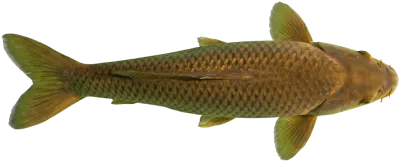
| Chagoi | Tea carp | Brown | Plain tea-brown, often the largest and tamest fish |
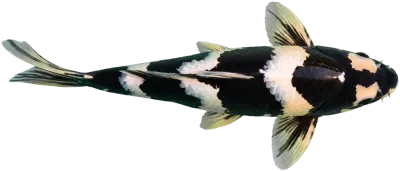
| Shiro Utsuri | White reflection | Black, white | Black body with flowing white patterns |
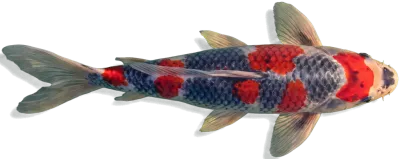
| Goshiki | Five colours | White, red, black, blues | Kohaku-like red over dark netted scales |
Each variety
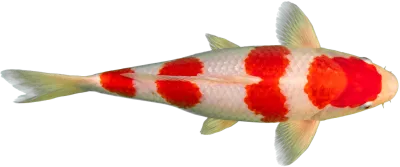
Kohaku
The classic koi and the one most people picture. Judges look for deep, even red with crisp edges on pure white skin. Kohaku is one of the Gosanke, the big three.
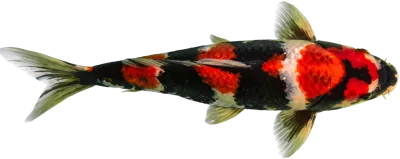
Showa Sanshoku
A black koi with red and white over it, first bred in the 1920s, early in Japan's Showa era. The black wraps around the body and usually reaches the head, which tells it apart from Taisho Sanke, the white koi with small black spots.
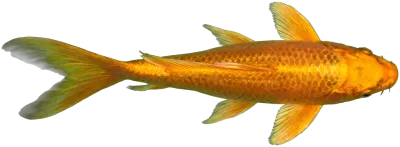
Ogon
A single metallic colour from nose to tail, developed in the 1940s. Ogon are bright, easy to see from above and a favourite for new ponds.
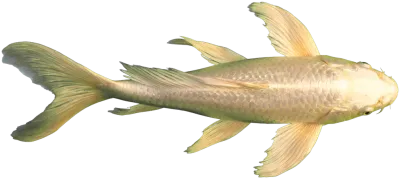
Platinum Ogon
The metallic white form of Ogon. In a dark pond it glows like moonlight on the water.
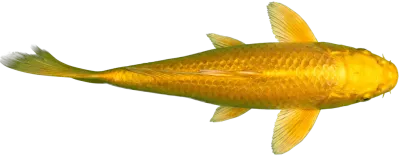
Yamabuki Ogon
The metallic yellow Ogon, named after the yamabuki, the yellow kerria flower of Japanese spring.
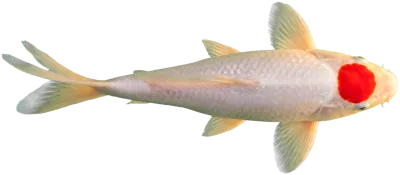
Tancho
White with one red spot on the head and no other red, named after the red-crowned crane. The spot echoes the Japanese flag, and a round, centred one is hard to breed, which makes good Tancho highly prized.
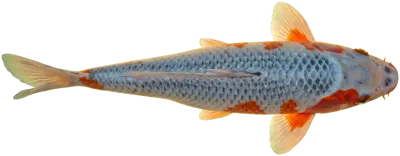
Asagi
One of the oldest varieties. Each blue-grey scale has a paler edge, making a net pattern down the back, with red or orange on the cheeks, belly and fins.
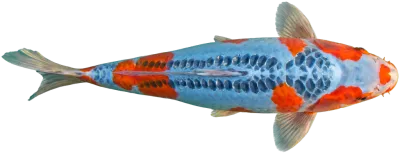
Shusui
A scaleless Asagi, bred in the early 1900s by crossing Asagi with German mirror carp (doitsu). It has smooth skin, with a line of large blue scales on each side of the dorsal fin running down its back.
Chagoi
Plain tea-brown and easy to overlook, but loved by keepers: Chagoi grow large and are famously calm, often the first fish to eat from your hand and the one that leads the others over.
Shiro Utsuri
A black koi with flowing white patterns, like ink and paper. Utsuri means reflection; its cousins Hi Utsuri and Ki Utsuri pair black with red or yellow.
Goshiki
Goshiki means five colours: white, red, black and two shades of blue. It looks like a Kohaku laid over Asagi's netted scales, and darkens as the water cools.
The Gosanke: the big three
Kohaku, Taisho Sanke and Showa Sanshoku are called the Gosanke. They are the varieties most often shown and judged, and the ones breeders spend the most effort on. A quick way to tell them apart: Kohaku has no black; Sanke is white with small black spots and no black on the head; Showa is black underneath, with black usually on the head.
What koi fish symbolise
Koi stand for perseverance and success. In the old Chinese legend of the Dragon Gate, carp try to swim up a waterfall on the Yellow River, and the one that reaches the top becomes a dragon. In Japan, carp streamers called koinobori fly on Children's Day, 5 May, as a wish for children to grow up strong.
Colours have popular modern meanings too, mostly from feng shui and tattoo traditions rather than one old source: red and white for love and success, gold for wealth, black for overcoming hardship and blue for calm. A pair of koi swimming together is often read as harmony between two people.
Questions
What are the three main types of koi?
The Gosanke: Kohaku (white with red), Taisho Sanke (white with red and black) and Showa Sanshoku (black with red and white).
What is the rarest type of koi?
Rarity depends on quality more than variety, but a Tancho with a single round red spot on its head and no other red is famously hard to breed and highly prized.
Are koi and goldfish the same?
No. Both are in the carp family, but koi come from common carp and goldfish from a different carp. Koi have two pairs of barbels (whiskers) at the mouth and grow much larger.
What does nishikigoi mean?
Brocaded carp: carp patterned like brocade cloth. It is the Japanese name for ornamental koi.
Raise all eleven. In Koi Garden for iPhone a new koi swims into your pond every second day you visit. The five common varieties arrive free; the six rare ones, from Tancho to Goshiki, come with the one-time unlock. You name each one, and they grow on the days you feed them. See Koi Garden →